
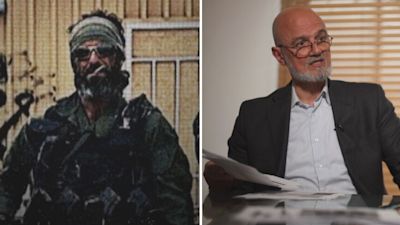
Sitting near the bar at the Bulgari hotel in Knightsbridge, Abraham Golan made short work of a succession of espressos. In a tailored shirt and flashy watch, he blended easily into the flow of executives rushing through the five star retreat, a place known for luxury and discretion. That was precisely the point. The success of his mission in London depended on him going unnoticed.
It was December 2016 and the hotel lobby was decorated for Christmas. Golan, a dual Hungarian-Israeli citizen who lived in the United States, had just arrived for a flying visit. He swept through the city in chauffeur-driven cars, dropping selective references to acquaintances about his exploits abroad, projecting an almost theatrical confidence. Yet for all that bluster, he revealed little about the secret mission that had brought him to the UK.
He did, however, tell associates at the Bulgari bar about a trip to Yemen almost a year earlier, where he took on a new role in a shadow war (mercenaries usually work for money rather than national loyalty, so moving between conflicts is nothing unusual). A former French Foreign Legion soldier, Golan had been hired by the United Arab Emirates, which paid his company, Spear Operations Group, millions of dollars to assemble a covert unit of Western military veterans for operations on the front line.
The team’s task in Yemen was to help hunt down and kill figures the Emiratis regarded as terrorists, including politicians accused of links to the Muslim Brotherhood. In effect, Golan and his team had become private assassins – contract killers – for a nation state, a classification which he and members of his team reject.
Now, though, he was energised by this new assignment in the UK. “It was like he still had the sand in his boots,” recalled one former colleague, describing Golan’s mood at the hotel bar in London. A year after his mission in Yemen began, the setting had changed, but the client had not – it was his work for the UAE that had brought him to London.
ITV News can reveal that Golan’s was in the UK to mount a covert surveillance operation against a British academic, on British soil – and all on behalf of a British ally.
Confidential Emirati records seen by ITV News and filed just two weeks after the London trip show that Golan was being paid by the UAE throughout his London operation, which included a month of planning and at least several days on the ground. The records also lay bare the financial incentives behind his contract with the Emiratis: a six-figure retainer for his work that year, plus huge bonuses: just a few weeks before his arrival in London, he received a one-million-dollar payout for an operation against a previous target in Yemen.
Golan was not acting alone. While in the UK, he referred to his “team” and worked alongside a former US Navy SEAL with whom he discussed ways to locate, track and potentially kill their target – a prominent political campaigner who Abu Dhabi had come to view as a threat.
Drawing on witness testimony, emails, text messages and secret records, this ITV News investigation exposes the hidden machinery of a covert operation conducted on the streets of the UK, raising troubling questions about the mercenaries who carried it out, but also about the state that funded them.
The target
Anas Altikriti, a hostage negotiator, an activist, and chief executive of a think-tank, sits at the dining table of his London home, sifting through a pile of emails, text messages and photographs. “I feel physically sick” he says as he reads through the scattered pages of conversations from 2016.
Altikriti has just been told he was the subject of Golan’s surveillance mission a decade earlier. ITV News has shared with him some of the messages sent at the time by the mercenary chief over WhatsApp and email. They clearly capture the planning of a shadowy operation.
A neatly-groomed 57-year old who lives in a suburb of London, Altikriti might appear an unlikely target for an assassin.
But as the chief executive of the Cordoba Foundation, a think-tank based in London, he is a well-known figure. He has helped to negotiate the release of more than 20 hostages across Africa and the Middle East. His public profile has been further enhanced by appearances on television as a commentator, and opinion pieces in newspapers.
Scanning the files in front of him, Altikriti spots messages containing his personal details: photographs of his home at the time – his distinctive black hatchback parked outside his bungalow. Images are labelled, simply, such as: “Target’s house and car.”
Altikriti shakes his head. “At the time my children were three and one and a half years old” he says.
Over WhatsApp, Abraham Golan shared maps and reconnaissance notes detailing Altikriti’s most likely routes from home to work – even the entrance he would use to his office block.
Some of the exchanges have been partially redacted by ITV News to protect sources, but what remains paints a detailed picture of the plans against him.
Although Altikriti is shocked, when asked who he suspects to have been behind Golan’s scheme, he answers without hesitation: “Oh, the UAE.”
The history
In November 2014, the United Arab Emirates published a list of newly proscribed terrorist groups, 83 organisations it had outlawed under laws against violent extremism. They included recognised networks like ISIS and Al Qaeda – along with surprise additions, including three mainstream British organisations.
The most high-profile was Islamic Relief, a longstanding partner for the UK’s international development department, which had received millions of pounds in taxpayer funding and which sat with other aid agencies, such as Oxfam and the Red Cross, on Britain’s official Disasters Emergency Committee. Now the UAE considered it a terrorist network. No official reason was given.
The second banned group was The Muslim Association of Britain. Like Islamic Relief, it emphatically rejected the classification. “Its claim against MAB does not survive scrutiny: no evidence has ever been produced, because none exists,” a spokesperson for the organisation said.
The third British group was the Cordoba Foundation, Altikitri’s small but influential think-tank, which had always said its purpose was to “provide a strong voice of tolerance and reason in promoting dialogue and a rapprochement between Islam and the West”.
News of these groups’ proscription left UK government officials searching for an explanation. Internal emails from the time show Whitehall grappling with how to press for the evidence behind the decision.
In an email on 18th November 2014, one British diplomat circulated suggested wording for conversations with representatives of the UAE: “As you have done previously, if you believe these organisations to be involved in terrorism, we would expect you to share your evidence and rationale with us, given our shared interest in countering terrorism.”
In the eyes of the UAE, according to sources, Cordoba was associated with a movement they regarded as an ideological threat – the Muslim Brotherhood, which it considers to be a terrorist organisation seeking to undermine its model of government. What lay behind their concern was Altikriti’s father, Osama Altikriti, who had once served as the head of the Iraqi Islamic Party, which has links to the Brotherhood. Cordoba Foundation has consistently denied any formal association with the movement.
“I have good relations, because my father is my father,” he said. “I understand the ideology, I studied the ideology of the Muslim Brotherhood; I believe the Muslim Brotherhood to be a valid ideology for people who are seeking to free themselves from the clutches of oppression.”
“However, I’m a Brit, I grew up in Britain,” he said. “In my life I have never done anything wrong whatsoever.”
Since the Arab Spring, the UAE has treated the Muslim Brotherhood as both an ideological rival and a threat to monarchical rule, seeking to suppress the movement at home and curb its influence across the Middle East.
But the UK perceives the group very differently – in 2015, a government review concluded there was no evidence that the movement was involved in terrorist activity in the UK.
The British government has continued to resist Emirati pressure to outlaw the group.
In 2015, the UAE turned its anti-Muslim Brotherhood policy into practice in Yemen. It hired Spear Operations Group, Abraham Golan’s private security company, to target political figures it believed were aligned with the Muslim Brotherhood. The Emiratis described the programme as counter-terrorism.
One of its first targets was Anssaf Ali Mayo, a Yemeni MP. Golan’s team planted explosives at the office building where Mayo worked. He survived the attack, but fled to Saudi Arabia. The attempted assassination is now the subject of a civil lawsuit brought by Mayo in California.
Golan later admitted his role in the programme. “There was a targeted assassination program in Yemen,” he told BuzzFeed News. “I was running it. We did it. It was sanctioned by the UAE within the coalition.”
Dale Comstock, a member of Golan’s team in Yemen and a US Special Forces veteran, also confirmed to ITV News that the operation in Yemen was carried out on behalf of the UAE. “For all intents and purposes, we were Emirati soldiers,” he said.
Days before the attempt to assassinate Mayo, Golan sent an email from the battlefield in Yemen with a request. He wanted a briefing on his target, so he reached out to a consultant strategist from the UK who had previously provided research for Golan during his other operations around the world. ITV News is calling him Victor.
Shortly afterwards, Victor produced a report describing Mayo as a “moderate” and a “pragmatist”. He was unaware his analysis would become part of an assassination plot the day after it was submitted to Golan.
Almost a year passed before Golan got back in touch with Victor. “Hope you good,” he wrote on November 17, 2016, the opening line to another request for Victor’s help, but this time, much closer to home.
He wanted to know whether Victor had any “channels” to Anas Altikriti and Cordoba Foundation, which the UAE had proscribed two years earlier. Golan attached a link to Altikriti’s Wikipedia page and added a warning: “Keep this ultra tight for you.”
Golan’s messages back and forth over the coming weeks would offer glimpses of something larger: “War is coming to Europe and we are at the beginning of a huge programme,” he wrote to Victor in one follow-up.
But he was planning his operation in London against the backdrop of growing diplomatic ties between Britain and the UAE. Just as Golan warned of violent conflict in Europe, his Emirati paymasters were publicly expressing their closeness to the UK government.
In fact, two weeks after Golan contacted Victor, the then Prince Charles travelled to Abu Dhabi to strengthen diplomatic and economic relations. The British government officials who accompanied him knew that disagreements over the Muslim Brotherhood remained a point of friction between the two governments. But they had no idea that while their visit was underway, mercenaries who claimed to be working on behalf of the UAE were preparing a covert operation in the UK.
The plot
In early December, Golan arrived in London and summoned Victor to meet him at a bar in central London. Alongside him was a former US special forces commando.
“There, he introduced me to his new associate, who I’d never met before” Victor recalls during an interview with ITV News.
“We were having a conversation and Abraham said to me: ‘Right, I’m working with the UAE and they regard Cordoba Foundation and Anas Altikriti in particular as aligned with terrorist groups in Syria, that they are radicalising young Muslims here and conscripting them to fight for ISIS or Al Qaeda.”
“He said some kind of surveillance operation was being created in London by the UAE to monitor these threats.
“It definitely seemed that there was financing to carry out some kind of operation in the UK – at least to put this man under surveillance, which in itself is a hostile act.”
To persuade Victor to help with the plot, Golan offered him £50,000 for his assistance, later increasing to £100,000. The money, he said, would come through an offshore account and a third party.
Messages seen by ITV News show the surveillance operation gathering pace. Golan asked Victor to lure Altikriti to an outdoor meeting by posing as an author writing a book about the Muslim Brotherhood. During a flurry of communication on 12th December, he demanded more intelligence: “Personal Address/cordoba address … cafe is going ? Mosque ?”.
Golan shared a surveillance file containing details of Altikriti’s home and workplace, photographs of both locations and satellite imagery identifying his likely approaches to his office.
“I became increasingly worried about what this operation entailed,” Victor told ITV News.
At a second meeting, Victor says the conversation took a darker turn.
Golan’s associate asked: ‘What would happen if Anas Altikriti was…’” – he fell silent and drew a finger across his throat. “That suggested to me that the operation was ultimately about – or could become about – physically eliminating Anas Altikriti,” Victor said.
At one point, Golan insisted on turning up at Victor’s home to discuss ways to find Altikriti.
“He pushed for another meeting with me. I refused to have him in my house. So we met in a pub. He drove up in a chauffeur-driven limousine and we sat and had a beer in the pub. I think he had Glenfiddich whiskey.”
“We’d had this meeting in the hotel and we had email exchanges where I became increasingly worried about what this operation entailed and he pushed for a meeting with me.”
But Golan’s stream of staccato messages continued – his tone grew more urgent.
In one, he wrote: “My friend, we will need to make a push on Intel as we are ready from the 15th afternoon”
Then, abruptly, Golan announced that he had left London. On 14th December, he messaged Victor from Washington DC, telling him their operation against Altikriti was still on track: “continue as all team are in London… But we still ON”.
Understanding this to be a potential assassination plot, Victor decided he wanted no further involvement and backed away. “So you give up, right?” Golan wrote in a midnight message on 19th December. “There’s nothing else I can do,” Victor replied.
It is unclear how the operation progressed, but Golan vowed to continue. Altikriti was subsequently contacted by the police in London, who warned him to be vigilant due to threats to his safety. During the two visits to his home, officers said they were not permitted to disclose the details of the threat.
“It was very worrying because [the police officer was saying] ‘by the way, you’re in danger but we are not going to tell you anything about the source of danger, the type of danger, what it is that you should do or not do in order to lessen, mitigate or avert that danger. That’s a fairly scary scenario to be placed in.”
“They asked me whether I’d heard of an Osman notice. I asked, ‘what is this about?’ They explained that [it means] they have sufficient information to believe that lives might be under threat.”
Altikriti has been more observant ever since, but only now has he learned what lay behind those warnings.
The evidence gathered by ITV News does not prove whether Golan’s London operation was conceived by figures inside the Emirati government or whether he took the plan to them, knowing the UAE regarded Altikriti as an enemy. What is clear is that when he arrived in London, he was on the UAE’s payroll and considered himself to be acting on its behalf. The messages he sent during his operation indicate he was working under some form of direction.
Two weeks after Golan returned to the US from London, accounts filed in the UAE, though never intended for public consumption, show some of the substantial payments made to Golan by Emirati authorities for his work during the preceding months: several million dollars in salary and occasional bonuses.
Abraham Golan refused to provide a substantive response to ITV News’ request for a comment. But in a brief message sent over social media, he said, “I have nothing to declare, I trust you will do your job.” Pressed again, he said he had “no interest” in speaking to ITV News.
Golan’s associate, the former US Navy SEAL who joined him in London, did not answer multiple requests by ITV News to provide a comment.
The United Arab Emirates’ embassies in the UK and USA have not provided a response to these findings.
A spokesperson for the UK Home Office said: “It is our longstanding policy not to comment on security and intelligence matters.”
Prime Minister Andy Burnham confirmed his intentions to extend ties with the UAE during a conversation with UAE President Sheikh Mohamed, one of the first calls with an international leader of Burnham’s premiership.
But an old source of friction remains. Emirati leaders continue to feel frustrated by the UK’s refusal to proscribe the Muslim Brotherhood, and by what they see as its failure to take action against British figures they believe to be aligned with the group.
For UK officials, these revelations raise a different question: whether Golan’s mission can be regarded as a permissible act by a third party working for a close ally – or whether it crossed the line into a hostile campaign on British soil, driven by a perception of the Muslim Brotherhood that continues to divide the two countries.
Source: ITV.COM