

Reflections after returning from Melbourne on why the November 14 standoff – and yesterday’s diplomatic rupture – demand a real national reset.
The last time I wrote here, it was October 28. The United Nations political mission was lowering its flag after more than a decade, and many of us warned that Somalia was stepping onto a high wire without a safety net.
Three weeks later, the wire has snapped.
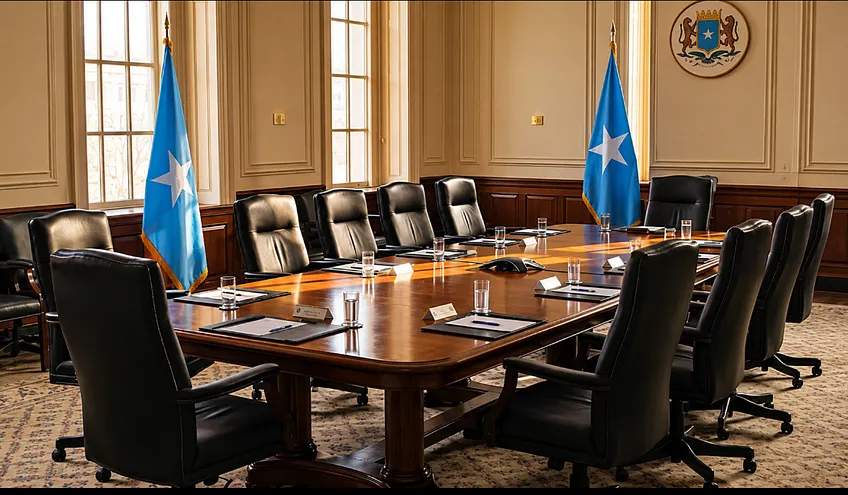
The November 14 “national consultative forum” called by Villa Somalia ended on Wednesday without ever truly beginning. For five days, the chairs inside the presidential compound sat empty. And yesterday, in what looked less like strategy than sheer desperation to change the subject, the administration abruptly gave the United Arab Emirates ambassador seventy-two hours to leave the country.
You do not need a diplomat’s briefing book to see how these events fit together.
Earlier this month, five judges of the Supreme Court did what a constitutional court is meant to do: they ruled that a unilateral term extension was unlawful and ordered the country back to the ballot box within ninety days. Rather than respecting that judgment, the incumbent administration issued a decree dismissing Chief Justice Bashe Yusuf Ahmed, surrounded the courthouse with armed troops, stripped judges of their security, and swore in a handpicked replacement – an assault on judicial independence that United Nations legal experts have since formally condemned.
You cannot lock the Chief Justice out of his chambers on a Wednesday, surround the court with soldiers on a Thursday, and expect serious political leaders or Federal Member States to walk into a palace conference room the following week simply to applaud a pre-written script. Nor can you manufacture a foreign-policy crisis with a major security and economic partner to paper over the fact that nobody at home showed up to your table.
I watched the early days of this standoff unfold while I was in Melbourne, sitting in community halls and over late-night dinners with Somali-Australian elders, business owners, and young professionals before boarding my flight back on the 16th. Stepping outside the daily tactical noise of our domestic politics clarifies what is actually at stake.
The citizens of our capital – who have endured decades of sacrifice, displacement, and insecurity to keep the heart of the republic beating – deserve far better than having their city turned into a militarised staging ground for political survival. And the millions of Somalis across every region who rely on a functioning federal state deserve better than watching the entire political class fight over who controls the referees while Al-Shabaab tests our frontlines and international troop footprints shrink.
Yet if we look honestly at the chessboard this morning, the failure of the November 14–18 talks exposes a deeper trap that implicates more than just the presidency.
Right now, Somalia is caught between two equally dangerous dead ends. On one side sits an incumbent administration trying to govern by executive decree and diplomatic brinkmanship. On the other sits a fractured opposition – caught between regional blocs boycotting the capital and factions quietly testing separate side-deals. Neither side holds a monopoly on wisdom, and neither side can force its will on the country without tearing the state apart.
History does not reward leaders who merely point out that the palace is on fire; it rewards those who bring water and build the exit.
The Supreme Court’s ruling has handed the country a clear constitutional clock. If we are going to arrest this slide before the end of the year, our political class must move past unilateral decrees, foreign scapegoating, and endless boycotts around four practical realities:
- De-escalate the Judiciary Immediately. No credible transition can be built on top of a broken court. Reinstating Chief Justice Bashe Yusuf Ahmed, restoring security to the bench, and pulling armed units out of judicial compounds is the non-negotiable baseline for any lawful process.
- Move Talks to a Neutral Venue Under Quartet Facilitation. If the palace is no longer trusted as a host, move the table to a neutral site in the capital facilitated by our core international partners – the United States, the United Kingdom, the European Union, and Turkey – where the presidency, Federal Member States, and the full spectrum of opposition leaders sit as equals rather than guests of an incumbent.
- Insulate Security and Foreign Policy from Election Politics. Elite units and intelligence leadership must be kept out of partisan maneuvers and focused squarely on stabilising the regions and the corridors into the capital. At the same time, a caretaker administration cannot sever vital bilateral relationships without parliamentary oversight or national consensus.
- Negotiate an Audited, Consensus Roadmap. Drop the illusion of a unilateral 2027 timetable. Sit down within the court’s mandate to agree on an indirect, verifiable electoral model rooted in the 2012 Provisional Constitution that every major stakeholder will accept.
Since returning from Australia earlier this week, one truth has become unmistakable: the era of one faction dictating terms to the rest of the republic is over. The empty chairs at Villa Somalia are a warning. Either our leaders summon the maturity to sit at a neutral table and forge a broad, constitutional settlement – or they will preside over the unraveling of the very state they are fighting to lead.