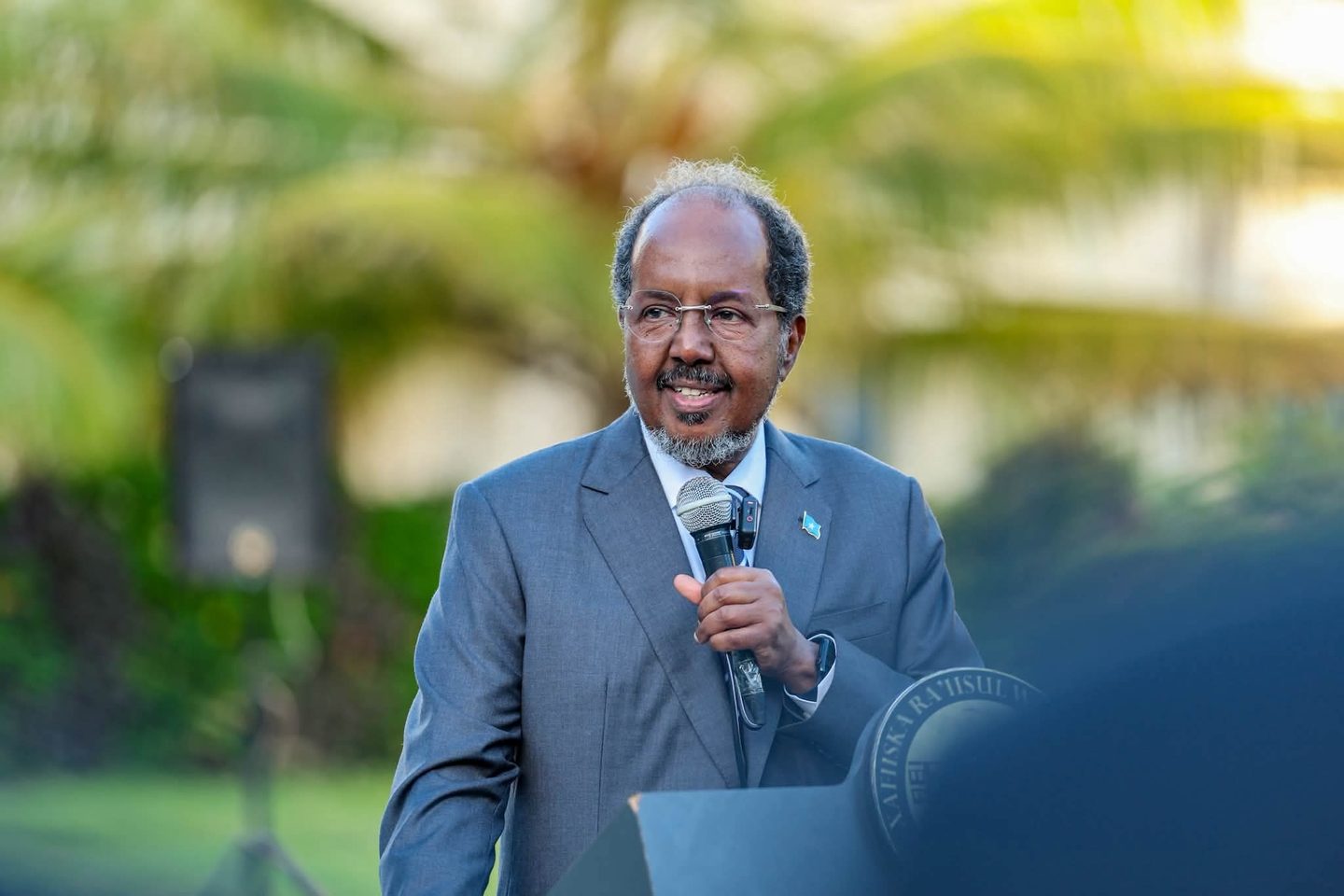
Mogadishu (PP Editorial) — Somalia is a country recovering from decades of conflict. If we take the end of the political transition in 2012, debt relief in 2023 and the lifting of the general UN arms embargo on the Federal Government in December 2023 as important milestones, the progress Somalia has made is significant. Somalia reached the HIPC Completion Point in December 2023, receiving about US$4.5 billion in debt-service relief and reopening access to new external financing.
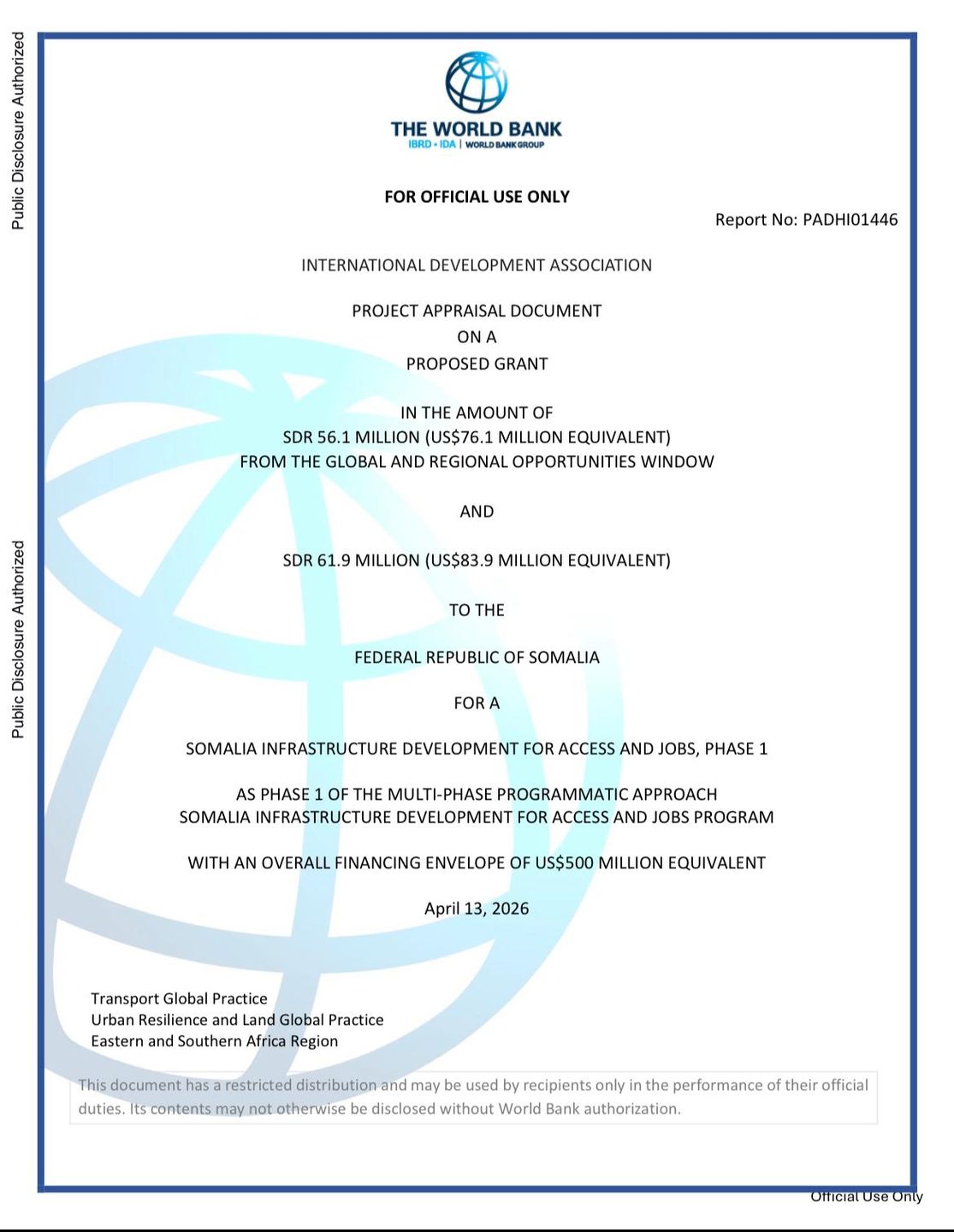
One example of Somalia’s renewed access to development finance is the World Bank’s Somalia Infrastructure Development forAccess and Jobs, Phase 1 (Stairs2Jobs), P513127.
The Project Appraisal Document is dated 13 April 2026; Phase 1 was approved on 5 May 2026 with US$160 million in the International Development Association grant financing. It forms part of a planned four-phase, ten-year programme with an overall financing envelope of US$500 million. The appraisal envisages Phase 2 at US$100 million, Phase 3 at US$190 million and Phase 4 at US$50 million, although these later phases are not the same as money already disbursed or guaranteed.
It is too early to conclude that the full four-phase programme will or will not be distributed fairly among its intended beneficiaries. Transparency therefore remains important. Somali political stakeholders have a legitimate interest in understanding how decisions about the geographical distribution of infrastructure investment are made, why particular areas are prioritised and how funding is allocated over the lifetime of the programme.
For Phase 1, the largest geographically identifiable allocations are US$68 million for resilient urban drainage in Mogadishu, equivalent to 42.5% of the US$160 million grant, and US$50.7 million for the Hargeisa-Salahley-Ina Guha economic corridor, equivalent to approximately 31.7%. Together, these two specific investments account for approximately 74.2% of Phase 1 funding.
These figures should, however, be described carefully. The 42.5% is the allocation to the Mogadishu drainage project, not necessarily Mogadishu’s complete benefit from Phase 1, because Mogadishu also appears within the wider airport programme. Similarly, the 31.7% is allocated to the Hargeisa economic corridor rather than being an unrestricted payment to Hargeisa.
After these two allocations, US$41.3 million or about 25.8%, remains. This money is not actually divided equally among the five Federal Member States mentioned in the grant application document. It includes US$19.5 million for airport investments, US$5.8 million for institutional transformation and capacity building, US$8.5 million for sustainable operations and maintenance, and US$7.5 million for project coordination and management.
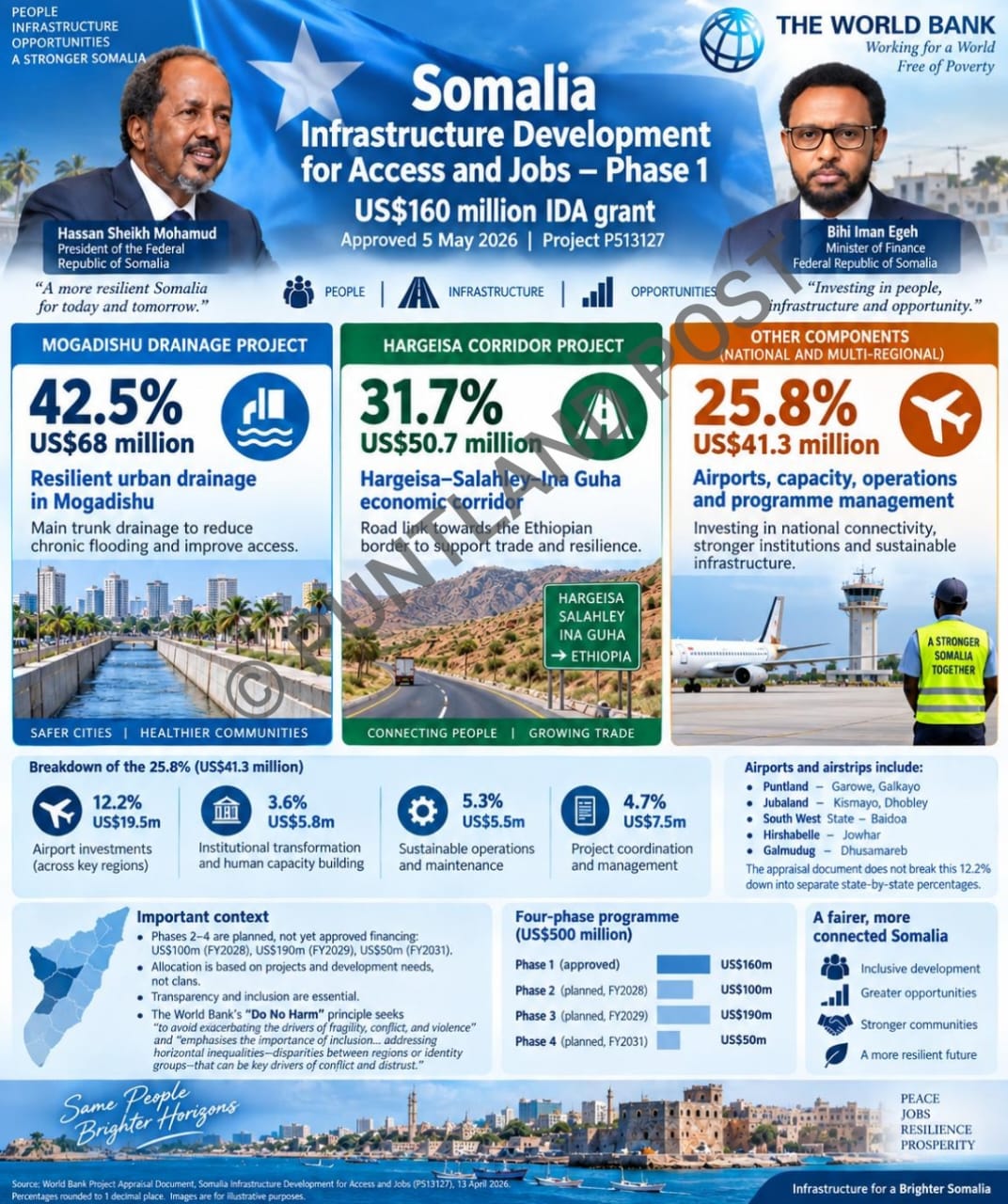
If, purely as a mathematical illustration, the entire remaining 25.8% were instead divided equally among Puntland, Jubaland, South West State, Hirshabelle and Galmudug, each would receive approximately 5.16% of the total grant or US$8.26 million. This hypothetical calculation must not be confused with the World Bank’s actual distribution, because much of the remaining funding is national or sector-wide rather than a state-by-state allocation.
Questions about distribution also need to be considered within Somalia’s wider governance environment. In its 2018 Promoting FCV-Sensitive Climate Action, the World Bank warned that “minimal trust in government is preventing the state from providing the public goods and services necessary to consolidate its legitimacy…”
Questions of political legitimacy and territorial authority also remain contested. Somaliland declared unilateral secession in 1991 but has political representation in the Federal Government of Somalia.
At a Hudson Institute event on 14 September 2026, Somaliland President Abdirahman Mohamed Abdullahi “Irro” discussed Somaliland’s political position and its relationship with Mogadishu. Abdirahman Mohamed Abdullahi “Irro”, President of the Somaliland administration, said that no Somali president had ever visited Hargeisa, the capital of Somaliland. He used this claim to challenge the Federal Government of Somalia’s sovereignty-based legitimacy over the territories controlled by the Somaliland administration.
Relations between the Federal Government and some Federal Member States have also been seriously strained. Puntland announced in 2026 that it would cease recognising federal institutions until an agreed constitutional settlement was reached, following disputed constitutional amendments. Jubaland announced in November 2024 that it was suspending relations and cooperation with the Federal Government following a dispute over its regional election.
These disagreements provide an important political context for debates about how internationally financed infrastructure projects are geographically distributed.
The figures can also be discussed in relation to Somalia’s 4.5 clan power-sharing framework, but considerable caution is necessary. Infrastructure financing is formally allocated to projects, corridors, institutions, cities and beneficiaries rather than to clans. Describing an infrastructure allocation as money “received” by a particular clan would therefore be misleading unless the project documentation itself allocated funding on that basis.
A more defensible approach is to compare the geographical distribution of investment. With 42.5% allocated specifically to the Mogadishu drainage project and 31.7% to the Hargeisa corridor, the important longer-term question is how the remaining regions and Federal Member States benefit across all four phases.
The issue, therefore, is not simply how much one city or region receives in Phase 1. The more important questions are whether the criteria for selecting projects are transparent, whether infrastructure needs are assessed consistently across Somalia, whether political disagreements affect project access or implementation, and whether the full four-phase programme ultimately produces a broadly equitable geographical distribution of development opportunities.
All these considerations bear on the World Bank’s principle of “Do No Harm”, which seeks “to avoid exacerbating the drivers of fragility, conflict and violence…” and “emphasizes the importance of inclusion… addressing horizontal inequalities—disparities between regions or identity groups—that can be key drivers of conflict and distrust.”
© Puntland Post, 2026