Adam H. Johnson’s How to Sell a Genocide: The Media’s Complicity in the Destruction of Gaza arrives at a moment when the relationship between war and information has become impossible to ignore.
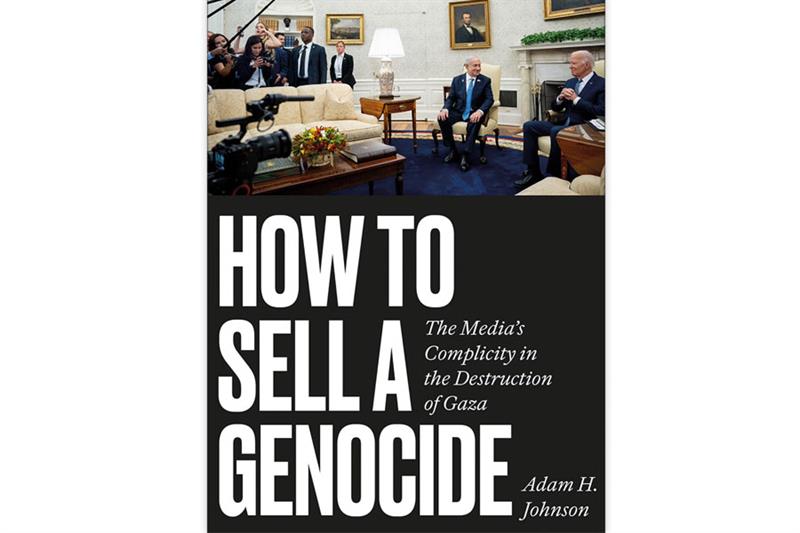
Published in 2026, after nearly three years of debate over the Gaza war that followed the Hamas attacks of 7 October 2023, the book examines not the military campaign itself but the narratives that accompanied it.
Johnson’s concern is neither battlefield strategy nor diplomatic negotiations. Instead, he asks how one of the most destructive conflicts of the twenty-first century was presented to the American public, how certain assumptions became accepted wisdom, and why large sections of the media appeared unable—or unwilling—to challenge the prevailing framework through which the war was understood.
The scale of the conflict provides the backdrop to the book. By the time Johnson completed his study, Gaza had experienced unprecedented destruction. Entire neighbourhoods had disappeared, universities and hospitals had been damaged or destroyed, and the humanitarian crisis had become the defining feature of the war.
The conflict generated one of the largest displacement crises in modern Middle Eastern history and prompted repeated warnings from humanitarian agencies regarding famine, disease, and the collapse of civilian infrastructure. Yet Johnson is less interested in recounting these events than in examining how they were represented. Why, he asks, did a catastrophe of such magnitude fail to generate the same political and media response that accompanied other recent humanitarian disasters?
The answer, according to Johnson, lies in the power of narrative. Wars are fought not only with weapons but also with stories. Governments seek military victories, but they also seek legitimacy. They need public support, diplomatic backing, and moral justification.
Modern media institutions play a central role in constructing these narratives. They determine which voices are amplified, which facts receive prominence, which images are repeatedly shown, and which events become part of the public imagination. Johnson’s argument is that major American media organizations did not simply cover the war in Gaza; they helped establish the moral framework through which the war was interpreted.
Unlike many critiques of media coverage that rely on isolated examples, Johnson builds his case through an extensive body of evidence. Drawing on more than 12,000 newspaper articles and 5,000 television segments from major American outlets, he attempts to identify recurring patterns in language, sourcing, framing, and editorial priorities.
He supplements this material with interviews involving journalists, editors, producers, and media insiders. The result is a study that combines quantitative analysis with narrative critique, seeking to move beyond anecdotal accusations of bias and toward a systematic examination of media behavior during wartime.
The book begins with the aftermath of October 7. The Hamas attacks killed approximately 1,200 people in southern Israel and resulted in the capture of hundreds of hostages. In the days that followed, global media attention focused intensely on the violence and the stories emerging from affected communities.
Johnson argues that this initial period was decisive because it established the emotional and political framework that would shape coverage for months to come. Narratives formed during the first days of a conflict often prove remarkably durable, even when subsequent evidence complicates or contradicts them.
One of the most discussed examples is the claim that Hamas fighters had beheaded dozens of babies. Johnson reconstructs how the story spread rapidly across news organizations, political speeches, and social media platforms before independent verification was available. The significance of the episode, in his view, extends beyond questions of factual accuracy.
Such stories functioned as symbols. They reinforced an image of Hamas not merely as a militant organization but as an embodiment of irrational and uniquely monstrous violence. The emotional power of the narrative helped shape public attitudes toward the military response that followed. By the time doubts emerged, the story had already influenced political discourse across the United States and Europe.
Johnson places this episode within a broader effort to frame the conflict through the familiar language of the post-9/11 “War on Terror.” Throughout the early stages of the war, Hamas was repeatedly compared to ISIS by political leaders, commentators, and media personalities. The comparison provided a ready-made interpretive framework for Western audiences. It reduced a complex political conflict to a struggle between civilization and barbarism, leaving little room for historical context or political analysis. Johnson documents how frequently these analogies appeared across major news outlets and argues that they helped establish a moral environment in which calls for restraint could be dismissed as naïve or irresponsible.
Yet, the most powerful sections of the book are not those dealing with sensational stories or political rhetoric. They are the chapters devoted to what Johnson calls selective empathy. Here he examines how Israeli and Palestinian suffering were represented differently across mainstream media coverage.
His findings suggest a persistent imbalance. Israeli victims were more likely to be individualized through names, photographs, family histories, and personal narratives. Palestinian victims often appeared as numerical totals embedded within reports about military operations. This distinction matters because journalism does more than transmit information. It shapes emotional understanding. Audiences tend to empathize with people whose lives they can imagine. When suffering is personalized, it becomes morally urgent. When it is presented primarily through statistics, it becomes abstract.
Johnson illustrates this pattern through numerous examples and comparative data. He examines the use of emotionally charged language across television broadcasts and newspaper coverage, showing how certain words were applied differently depending on the victims being discussed. Terms such as “massacre,” “slaughter,” “murder,” and “atrocity” appeared more frequently in relation to Israeli casualties than Palestinian ones, even during periods when Palestinian civilian deaths vastly exceeded Israeli casualties. The issue is not merely linguistic. Language determines the moral intensity with which audiences perceive events.
The author strengthens his argument through comparisons with media coverage of Ukraine. Following Russia’s invasion in 2022, Western media organizations devoted extensive attention to civilian suffering, attacks on infrastructure, allegations of war crimes, and the experiences of displaced populations.
Johnson observes that many of the same institutions adopted noticeably different approaches when reporting on Gaza. Civilian deaths in Ukraine were often foregrounded as the central story. In Gaza, military objectives and strategic considerations frequently occupied greater prominence. Discussions of international law, accountability, and genocide also appeared under different standards. The comparison raises uncomfortable questions about consistency in journalistic practice and the influence of political context on reporting.
A recurring theme throughout the book is the relationship between journalism and power. Johnson challenges the conventional image of the press as an independent institution standing apart from government. He argues that major news organizations often operate within assumptions established by political elites. Access journalism encourages reporters to cultivate relationships with officials, military sources, and policymakers. These relationships provide valuable information but can also shape the boundaries of acceptable debate.
Throughout the Gaza war, statements from American and Israeli officials often dominated news coverage. Humanitarian agencies, legal experts, medical organizations, and independent investigators were present but rarely occupied comparable positions of authority. Johnson argues that this reflected a hierarchy of credibility embedded within mainstream journalism. Government sources were generally treated as authoritative, while critics of government policy frequently faced greater scrutiny and higher evidentiary standards. The result was a public discourse that often reproduced official assumptions even when journalists sought to remain neutral.
The chapter examining hospitals is particularly revealing. Medical facilities became central symbols of the conflict, generating competing narratives about military necessity and civilian protection. Johnson argues that media organizations frequently accepted official claims regarding military targets with limited skepticism while demanding more extensive verification from humanitarian organizations documenting the consequences of military operations. Whether one accepts this criticism entirely or not, the discussion highlights the challenges journalists face when reporting under conditions of limited access, intense political pressure, and competing claims.
Johnson also devotes considerable attention to the American domestic debate surrounding Gaza. Campus protests, accusations of antisemitism, congressional hearings, and public controversies generated enormous media attention.
According to Johnson, coverage frequently focused on the legitimacy of dissent rather than the substance of the issues being raised. Student activists, university administrators, and political controversies often became the story, while the humanitarian crisis that inspired the protests receded into the background.
The discussion of antisemitism is among the book’s most sensitive sections. Johnson does not dismiss concerns about antisemitism, nor does he deny its presence within public discourse. His argument is that accusations of antisemitism often received significantly greater attention than discussions of anti-Palestinian discrimination or civilian suffering in Gaza. The imbalance, he suggests, shaped the terms of public debate by shifting attention away from the war itself and toward disputes about the legitimacy of criticism.
Perhaps the most moving chapters focus on journalists working inside Gaza. Hundreds of Palestinian journalists continued reporting despite displacement, injury, loss of family members, and extreme personal danger. Their reporting provided much of the world’s understanding of conditions on the ground. Yet, Johnson argues that their experiences rarely received the same level of recognition afforded to journalists covering other conflicts. While Western reporters are often celebrated as defenders of press freedom, Palestinian journalists frequently remained invisible within broader media narratives despite operating under extraordinarily dangerous conditions.
The book is not without shortcomings. Johnson writes as an advocate as much as an analyst. His perspective is explicit, and his moral judgments are rarely concealed. Some readers will view this clarity as a strength. Others may question whether the book occasionally sacrifices nuance for the sake of argument. There are moments when institutional failures, structural incentives, and editorial decisions seem to merge into a single narrative of complicity. Critics may argue that the realities of wartime reporting are more complex than Johnson sometimes acknowledges.
Yet, even readers who disagree with aspects of the book will find it difficult to dismiss its central questions. How should journalists report on mass violence? What responsibilities accompany claims of neutrality? How can news organizations maintain independence while relying on official sources? When does balance become distortion? And how do narratives influence the public’s capacity for empathy?
These questions extend well beyond Gaza. Johnson repeatedly situates his analysis within a longer history of wartime journalism, drawing implicit comparisons with Vietnam, Iraq, Afghanistan, and the broader War on Terror. The issue, in his view, is not simply one conflict or one region. It is the enduring relationship between information, power, and public consent in democratic societies.
In the end, How to Sell a Genocide is best understood not as a history of the Gaza war but as an examination of how societies come to understand war itself. It is a study of the stories that accompany violence, the institutions that shape those stories, and the moral consequences that follow. Johnson’s conclusions will remain controversial. His interpretation of events will continue to provoke debate. But the questions he raises about journalism, accountability, and human empathy are unlikely to disappear.
At a time when trust in media institutions is under strain and information itself has become a battleground, Johnson’s book offers a reminder that narratives matter. They influence not only what people know but also what they feel, what they ignore, and what they ultimately accept. Whether one agrees with his conclusions or not, How to Sell a Genocide stands as one of the most significant contributions to the debate over media performance during the Gaza war and one of the most searching examinations of journalism’s role in modern conflict.
Source: Al Ahram Online