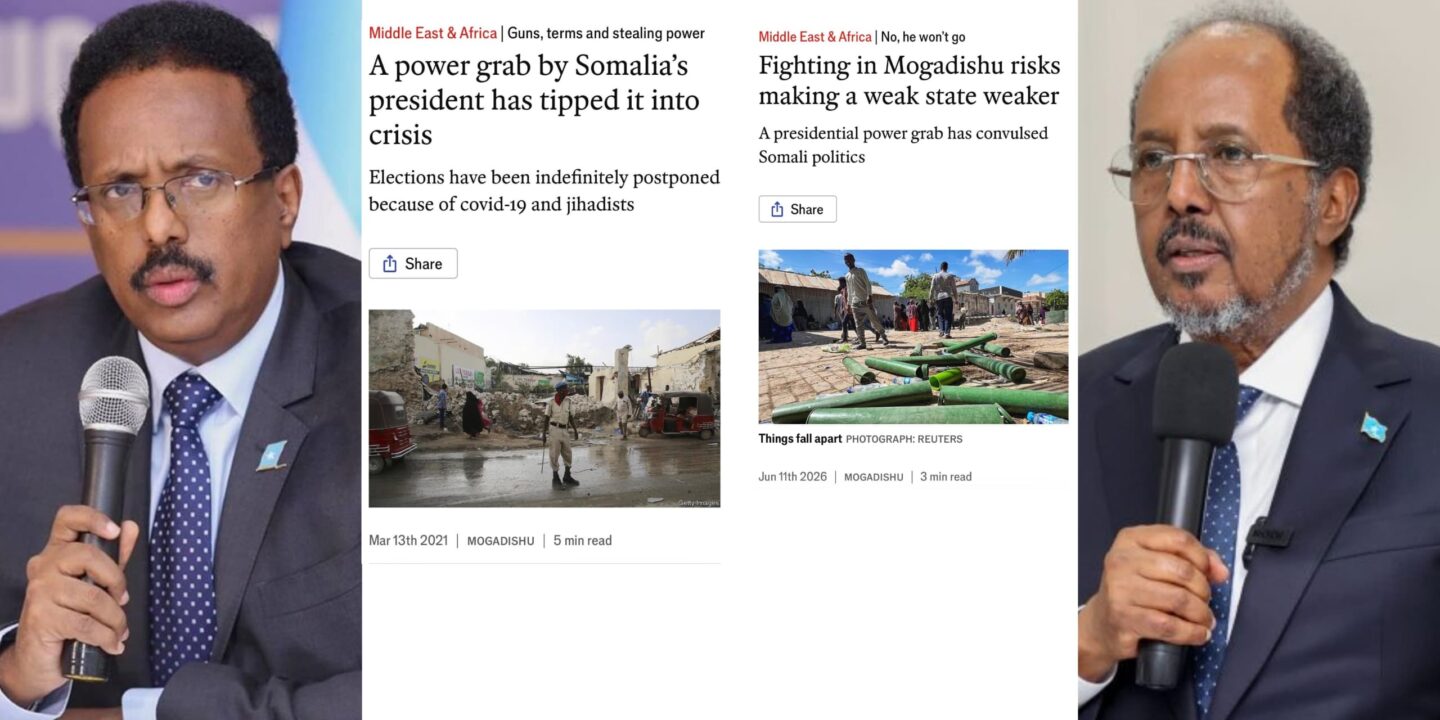
Mogadishu (Commentary) —The Economist, the London-based “newspaper”, is known for reports without by-lines. It is an old publication that is dumbing down. The causes of its decline have more to do with a lack of journalistic memory. Its reporters and editors do not bother consulting bound collections of the newspaper (it calls itself a newspaper) to ensure that tired stereotypes do not pass for reportage.
In its latest edition, a report on Somalia used the term “power grab” in the same cavalier manner it used five years ago: “a power grab by Somalia’s president” (in 2021) and “a presidential power grab” (in 2026). In 2021, the former president had his term extended unlawfully after his mandate had expired, but in 2026 constitutional amendments preceded the term extension.
The Economist misleads readers when it describes the group of politicians opposed to the constitutional amendments as “the opposition”. Only when a country transitions to a multiparty system, whereby political parties contest for power in a fair manner, can a country be said to have an opposition.
There are political parties in Somalia, but some of those parties oppose one-person, one-vote elections. The constitutional amendments were adopted in line with articles in the Provisional Constitution of Somalia. It was absurd to see a former Somali Prime Minister mobilise clan militias in a neighbourhood in Hawl Wadaag District, not far from the Somali Presidency, in the manner he did in 2021 against the former President of Somalia, Mohamed Abdullahi Farmaajo. Former Somali President Sharif Sheikh Ahmed attempted to foment an insurrection in Abdi Aziz District in north Mogadishu, but to no avail.
Flat Earth News: An Award-winning Reporter Exposes Falsehood, Distortion and Propaganda in the Global Media, a book by a former Guardian reporter, brought to light how some Western publications publish reports planted to mislead readers. The tell-tale signs of some of those reports are factual errors and a glaring absence of nuance. Those who plant stories in the media often reach for stereotypes. What better way to recycle political stereotypes in an ostensibly esteemed weekly publication than by failing to understand how that same publication reported on the country concerned, Somalia in this case?
The answer may be found by rephrasing the question as a media studies research theme in an era of fake news and deepfakes.
© Puntland Post, 2026