Chinese President Xi Jinping’s visit to Egypt comes as relations between Cairo and Beijing enter a new phase, according to Egyptian diplomats and foreign-policy experts, who point to expanding cooperation in investment, advanced technology, artificial intelligence, renewable energy, manufacturing and African development.
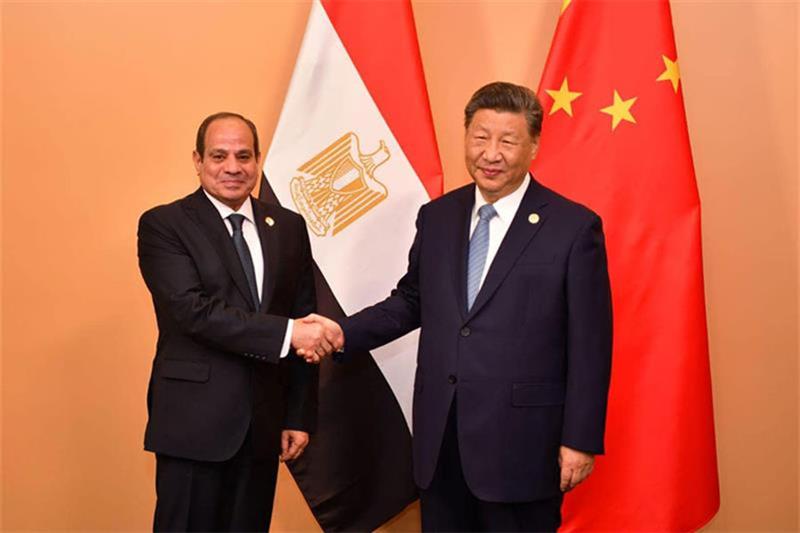
The visit coincides with the 70th anniversary of diplomatic relations between the two countries and comes a decade after Xi’s landmark visit to Cairo in 2016, which helped consolidate Egypt’s position within China’s broader policy towards the Arab world and the Middle East.
Ambassador Ezzat Saad, executive director of the Egyptian Council for Foreign Affairs (ECFA), said Egypt and China represent two of the oldest civilisations in human history. He noted that the 70th anniversary also coincides with the 13th anniversary of the Belt and Road Initiative (BRI), launched by Xi in 2013.
The initiative has acquired particular importance within Egypt-China relations, Saad said, describing it as the world’s largest platform for international cooperation, with more than 150 countries and nearly 30 international organisations participating in it.
This year also marks 10 years since Xi’s historic visit to Cairo, during which he delivered a major address at the headquarters of the Arab League and presented China’s policy towards the Arab world.
Saad said China’s Arab Policy Paper, which continues to provide the framework for Beijing’s engagement with the region, comprehensively defined the principles, objectives and areas of Arab-Chinese cooperation. It also affirmed the concept of common and sustainable security in the Middle East and supported efforts by Arab and regional states to establish a regional security mechanism based on collective cooperation.
The policy indicated that the Arab region generally, and Egypt particularly, had acquired greater strategic significance in Chinese foreign policy under Xi as part of Beijing’s broader westward orientation, Saad added.
Relations gained considerable momentum following President Abdel-Fattah El-Sisi’s assumption of office in 2014, particularly because of his appreciation of China’s experience in achieving comprehensive and sustainable development. The two countries subsequently elevated their relationship to a comprehensive strategic partnership.
In a congratulatory message to Xi on the centenary of the Communist Party of China, El-Sisi expressed his admiration for the Chinese development experience and highlighted the party’s role in advancing the country’s strategic objectives. These achievements included eliminating extreme poverty, improving living standards, transforming China into the world’s second-largest economy and establishing it as the leading global trading power.
Saad said Egypt and China share a broadly similar understanding of international relations, founded on multilateralism, dialogue, cooperation, mutual interests, reciprocal benefits, non-interference in domestic affairs, common security, respect for differing value systems, peace through development and civilisational harmony.
With Chinese political support, Egypt began engaging with BRICS through the BRICS Plus framework in September 2017. China introduced the format during the BRICS summit in Xiamen, which El-Sisi attended at Xi’s invitation.
Beijing subsequently supported Egypt’s accession to the New Development Bank, the financial arm of BRICS, in 2023. Egypt became a full member of the grouping on 1 January 2024.
Ambassador Mohamed Hegazy, a former assistant foreign minister and ECFA member, described Egypt-China relations as a distinguished model of cooperation between two countries possessing considerable historical and civilisational weight.
Their relationship rests on a shared commitment to sovereignty, non-interference in domestic affairs, cooperation, development and a more balanced and equitable international order, Hegazy said.
The 70th anniversary represents an important opportunity to review a long record of cooperation extending beyond political relations into economic, investment, cultural, scientific and technological fields.
China has become one of Egypt’s most important economic partners, while Egypt provides Beijing with a strategically located gateway to Arab and African markets through its ports, transport networks and the Suez Canal. Egypt, in turn, benefits from Chinese investment, expertise and technology in infrastructure, energy, transport, telecommunications and industry.
Hegazy also pointed to a clear convergence between Cairo and Beijing on several regional and international issues, particularly respect for international law and the UN Charter, the peaceful settlement of disputes and the right of peoples to self-determination.
This convergence has contributed to growing coordination between the two capitals on the Palestinian cause, Red Sea security and stability in the Middle East, he added.
The 70th anniversary should be regarded as a starting point for the future rather than merely a historical commemoration, Hegazy said. The international system is undergoing rapid transformation and moving towards greater multipolarity. China has emerged as a major economic, technological and political power, while Egypt retains its position as a pivotal regional state and a strategic geographical link between Africa, Asia and Europe.
The next phase could produce a qualitative shift in bilateral relations through greater emphasis on technology, artificial intelligence, new and renewable energy, advanced manufacturing, technology transfer and the localisation of production.
Hegazy also called for expanded Egyptian-Chinese cooperation in Africa so that the partnership develops beyond its bilateral framework into a platform for trilateral cooperation involving Egypt, China and African countries.
Professor Amira El-Shinnawi, a political science and international relations specialist and ECFA member, said relations between Egypt and China had developed substantially over several decades, culminating in the establishment of the comprehensive strategic partnership.
Chinese investments in Egypt have exceeded $10 billion, she said, while the two countries have cooperated on major infrastructure projects and expanded their cultural exchanges through events at the Cairo Opera House and art exhibitions documenting the longstanding friendship between their peoples.
El-Shinnawi said linking the Belt and Road Initiative with Egypt’s Vision 2030 development agenda had helped drive the considerable expansion of bilateral relations in recent years.
China regards Egypt as a pivotal partner in the Middle East and Africa and recognises its political and economic weight, which makes Cairo a central actor in Chinese cooperation with the Arab and African worlds, she said. China’s vast territory and strategic geographical position, meanwhile, have made it an important hub linking regions and markets across the world.
Egypt and China represent two of the world’s oldest civilisations and possess cultural and human connections extending over centuries. Egypt’s decision to become the first Arab and African country to recognise the People’s Republic of China gave the relationship a distinctive historical dimension.
Their relations have since been characterised by a high degree of political trust and close coordination on regional and international issues, El-Shinnawi said.
Cooperation is no longer confined to traditional sectors. It has expanded into advanced technology, artificial intelligence, renewable energy and electric vehicle manufacturing.
The Egypt-China cooperation model rests on mutual respect, shared interests, long-term planning and continuity at a time when international alliances and global balances of power are undergoing profound change, she added.
Ambassador Ali El-Hefny, an ECFA member and vice-president of the Egyptian-Chinese Friendship Association, said the history and depth of relations between the two countries extend far beyond seven decades of formal diplomatic ties.
Connections between the Egyptian and Chinese civilisations date back thousands of years and include commercial contacts and exchanges of knowledge, expertise and culture, he said.
The year 1956 did not mark the actual beginning of relations, El-Hefny explained. Rather, it represented Egypt’s formal recognition of the People’s Republic of China and its endorsement of the One China principle. That decision gave the relationship a distinctive historical character and subsequently influenced the development of China’s relations with the broader Arab world.
Egypt played a prominent role in the 1955 Bandung Conference in Indonesia, where late Egyptian president Gamal Abdel-Nasser held a historic meeting with late Chinese premier Zhou Enlai. The meeting became one of the principal milestones that prepared the ground for building strong and steadily developing relations between Cairo and Beijing.
El-Hefny said El-Sisi’s visit to China in 2014 demonstrated Egypt’s clear recognition of the importance of strengthening relations with Beijing, introducing greater balance into Egyptian foreign policy and maximising the economic and strategic benefits offered by the partnership.
The substantial development of bilateral relations in recent years reflects a high degree of understanding and agreement between Cairo and Beijing on numerous regional and international issues, he added.
Egypt was among the countries that worked with China to establish the Forum on China-Africa Cooperation in 2000. It also participated in establishing the China-Arab States Cooperation Forum in 2004, reflecting Cairo’s role in strengthening China’s partnerships with both the Arab and African worlds.
Egypt’s BRICS membership and its relationship with the Shanghai Cooperation Organisation have opened further opportunities for cooperation with China through multilateral organisations and economic groupings.
El-Hefny said Egypt-China relations had entered their eighth decade with greater diversity and a stronger focus on modern, knowledge-based sectors. Bilateral cooperation now encompasses digital transformation, artificial intelligence, industrial localisation, technology transfer and advanced technologies.
Cooperation also extends into the space sector, including the launch of Egyptian satellites from China and joint work on their production and development.
These projects demonstrate that Egypt-China relations are moving beyond conventional economic cooperation towards a partnership increasingly founded on knowledge, technological development and innovation, El-Hefny concluded.
Source: Al Ahram Online