
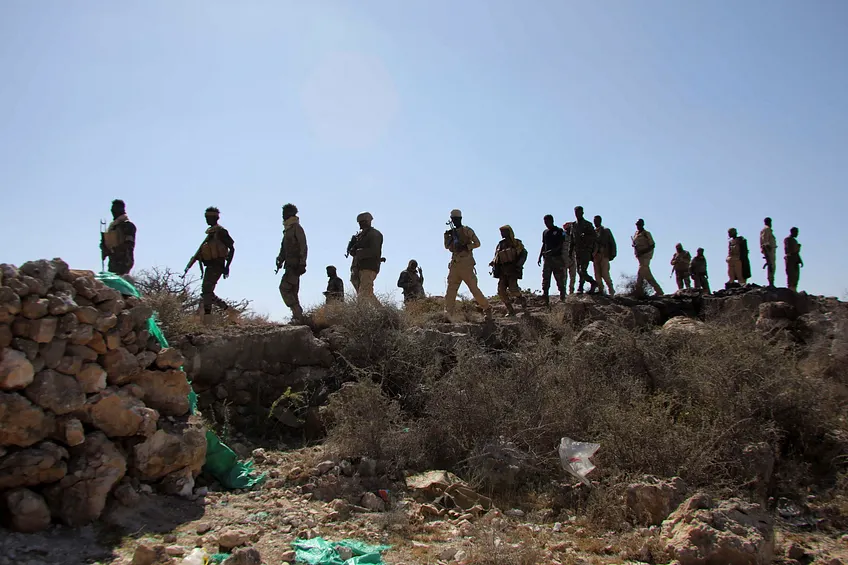
MOGADISHU, Somalia — Drones had been hovering over Togga-Xarago—a mountainous settlement in northeastern Somalia all day. The Reer Yusuf Mohamud Salah family was used to the noise; it was a regular occurrence in the Al-Miskaad mountains, where the Puntland security forces are waging an on-going war against ISIS militants, supported by the UAE and now the U.S.
On the evening of January 26, 2025, as her family gathered for dinner in their traditional Somali style hut known as an Caqil Soomaali, 38-year-old Khadra Abdi Ismael went to a neighbor’s home to retrieve an item for her relatives. Moments later, Khadra heard the large engine roars of an aircraft hovering above.
A large explosion followed. Thick smoke billowed through the sky as screams could be heard from the ruins of the hut, Khadra told Drop Site.
“The Caqil Soomaali was engulfed in flames, and smoke was everywhere,” Khadra said.
“Once the smoke cleared, the true horrors emerged: I saw shrapnel from the missile and body parts strewn everywhere,” she said. “Even the livestock were ripped to pieces.”
Four of her family members were killed and five were wounded. Khadra’s older sister, Ladan Abdi Ismael, and her 13-year-old son Abdisamad Yusuf Mohamud were both killed alongside seven-year-old Mohamed Abdiqani Mohamed and 17-year-old Hawa Ahmed Salah, who was four months pregnant. Salah was holding her 8-month-old child on her lap—who miraculously survived the drone strike.
“The child survived but she didn’t,” Khadra tells Drop Site.
Four separate security officials from the semi-autonomous Puntland region confirmed to Drop Site that the strike on January 26, 2025 targeting the Reer Yusuf Mohamud Salah family in the vicinity of Togga-Xarago was carried out by the United Arab Emirates. They were granted anonymity to speak about sensitive issues.
Drop Site reached out to the UAE embassy in Mogadishu and the UAE Ministry for Foreign Affairs for comment on the airstrike, as well as their operations from the military base in Bosasso. The Emirati diplomatic mission in Mogadishu or UAE foreign affairs did not respond to our queries.
There is currently no official, comprehensive data available on the exact number of civilian casualties in the war on ISIS. The airstrikes and clashes take place in remote, mountainous areas inhabited by small, isolated Bedouin communities. These areas are difficult for journalists, human rights organizations, and media outlets to access, making it extremely challenging to establish the full human cost of the conflict.
Puntland security officials add that the drones used in the strike set off from a UAE military base on the grounds of the airport in Bosasso. Those drones, the security officials say, are used for the sole purpose of counter terrorism operations in the Puntland region, targeting fighters of the Islamic State active in the Al-Miskaad mountains, with the UAE carrying out numerous strikes targeting militants during the first quarter of 2025, which picked back up during the last quarter of 2025.
A second Puntland security official interviewed by Drop Site stated that the UAE military base at Bosasso was more expansive than the current U.S. presence at the airport, which is limited to an intelligence command center where AFRICOM and CIA personnel are stationed, aligning with recent findings by Drop Site.
Just weeks before the January 26 strike, the Reer Yusuf Mohamud Salah family had been living in the settlement of Dhadaar in the Al-Miskaad mountains, which they have called home for generations.
In early December, government forces had informed the Bedouin family and others in Dhadaar that this was an area where ISIS was present, and ordered them to leave. Ahmed Abdi Ismael, the brother of Khadra similarly told Drop Site that his family was ordered by government forces to leave the area and relocate to a designated “safe zone” to be spared from the fighting against ISIS.
“My family was among many people that fled after being ordered to move by the government,” Ahmed said. “They were told to move and that this new area would be safe from the fighting, but they were bombed anyway.”
The family is still devastated by the effects of the strike. Habibo Yusuf Mohamud, who was pregnant at the time, “lost movement in her arm and still has shrapnel lodged in her neck,” Khadra told Drop Site. “Every time she tries to turn her neck, she feels excruciating pain.”
The Reer Yusuf Mohamud Salah family also lost six camels and 400 goats, destroying the family’s livelihood by eliminating their only source of income.
Following the UAE drone strike, the wounded survivors were moved on their neighbors’ camels, eventually reaching the government-controlled town of Balidhidin. In 2021, ISIS militants assassinated the mayor of Balidhidin, and fighters loyal to the group are still believed to be active in the area. From there, those with more serious injuries were transported to the port city of Bosasso for better medical treatment.
In January 2025 during the start of the war against ISIS in the Al-Miskaad mountains in the Puntland region, the UAE was not only carrying out drone strikes but air dropping supplies to Puntland ground forces with large cargo planes in areas of the Al-Miskaad mountains, where reliable road access was non existent.
Since November 2025, the UAE has not carried out a drone strike in the Puntland region of Somalia and since the start of this year, their anti terror operations have lessened, despite ISIS remaining an active threat in the Al-Miskaad mountains of Somalia. According to Puntland security officials, the U.S. has taken the lead and is currently spearheading the war against ISIS in the Puntland region.
As UAE drone strikes have halted in 2026, the Emirates are still remain actively involved in security operations in Puntland in support of local forces, in particular the Puntland Maritime Police Force (PMPF), tasked with combating armed non-state Islamist actors and anti-piracy operations.
The United Arab Emirates supports the PMPF with training, pays their salaries, and collaborates with them in intelligence gathering. The extensive Emirati support has transformed the PMPF into the most powerful state security apparatus in Puntland.
The current director general of the PMPF is a close family member of Puntland’s ruling leader Said Deni; as of October 9, the Puntland regional president is currently in Abu Dhabi in the United Arab Emirates, Puntland security officials privy to his itinerary told Drop Site.
The Puntland security officials that spoke with Drop Site declined to go into further details about the purpose of the Puntland’s president’s trip to the UAE, with one Puntland security official simply saying, “He traveled alone.”
“Our family hasn’t returned to the area [Togga-Xarago] because there isn’t anything to return to because we lost all our livestock in the strike,” Khadra said. “Even here in Balidhidan, we still see planes flying over, and it reminds us of what happened to our family that night.”
Four Puntland security officials with intricate knowledge on UAE military operations in Puntland have told Drop Site that UAE drone strikes have been “catastrophic” and at times “reckless.”
“When the US carries out a strike, their is a lot of surveillance that takes place beforehand. Oftentimes, the US surveillance drones will carry out reconnaissance on a target in the mountains for a lengthy period of time, then carry out a lethal strike but the Emirates fire on anything that moves,” a Puntland security official tells Drop Site.
“With the Emirates, there is no level of accountability. If they see a group of people burning wood somewhere in the [Al-Miskaad] mountains, they won’t even care to verify if these individuals are nomads or Daesh [ISIS],” a second Puntland security official said.
“It’s like target practice for them,” he said.